Stand at any signal in Bengaluru, Pune or Delhi and count the two-wheelers around you. A few years ago, motorcycles clearly outnumbered scooters. Today the gap is closing fast. Scooters made up 39% of all two-wheeler sales in India in the first half of 2026, their highest share ever, according to Autocar India.
That shift raises a practical question for anyone buying a city ride: scooter vs motorcycle, which actually works better on Indian streets? The answer depends on your commute, your roads and what you carry every day. This guide compares the two on traffic handling, mileage, comfort, safety, practicality and cost. If you'd like the bigger picture first, the guide to the different types of motorcycles in India on Khelo24race covers every category.
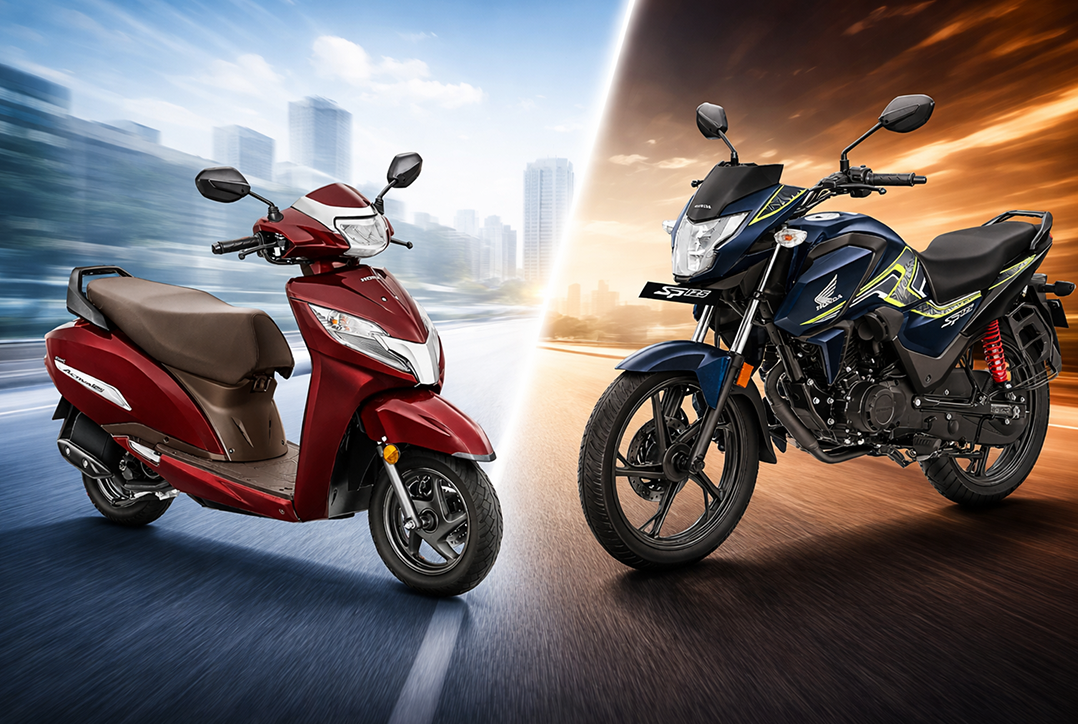
A scooter is gearless. It uses an automatic transmission (a CVT), so you just twist the throttle and go. You sit with your feet on a flat floorboard, the engine sits near the rear wheel, and the wheels are small. The popular Honda Activa 110, for example, rides on a 12-inch front wheel and a 10-inch rear.
A motorcycle usually has a manual gearbox and a clutch. You sit astride the fuel tank, the engine is mounted in the middle of the frame, and commuter bikes typically use much larger 17- or 18-inch wheels. Those design choices explain almost every difference that follows.
| Factor | Scooter | Motorcycle | Edge |
|---|---|---|---|
| Stop-and-go traffic | No clutch or gears | Constant clutch work | Scooter |
| Ease of learning | Very easy | Needs clutch and gear practice | Scooter |
| Mileage (110cc class) | Lower | Higher | Motorcycle |
| Storage | Under-seat space, floorboard, hooks | Little or none | Scooter |
| Potholes and rough roads | Small wheels feel every bump | Larger wheels roll over better | Motorcycle |
| Highway and long rides | Fine for short stretches | More stable and comfortable | Motorcycle |
| Electric options | Wide choice | Limited | Scooter |
The scooter wins comfortably. With no clutch to hold and no gears to change, crawling through a jam takes almost no effort. That matters on a daily 40-minute commute with dozens of stops. Scooters are also easy to manoeuvre at walking pace and simple to park in tight spaces.
Motorcycles aren't hard work in traffic, but the constant clutch use does tire your left hand over time. Riders who enjoy changing gears may not mind, but for pure convenience the scooter is ahead.
Commuter motorcycles have the edge here. A 100–125cc commuter bike can deliver around 60 to 85 km/l in real-world riding, while most 110cc scooters return noticeably less, often around 45 to 55 km/l. The CVT that makes scooters so easy to ride is a little less efficient than a manual gearbox.
If you ride 30 km or more every day, that gap adds up to a meaningful monthly saving on fuel.
On smooth city roads both are fine. On broken roads, speed breakers and potholes, the motorcycle's bigger wheels and longer suspension make a clear difference. Small scooter wheels drop into holes more sharply and transmit more of the jolt to the rider. Motorcycles also feel more stable at highway speeds and in crosswinds.
This is where scooters shine. Under-seat storage can hold a helmet or grocery bags, the flat floorboard can carry a gas cylinder or a bag, and many scooters have front hooks and charging sockets. The step-through design also suits riders wearing sarees, skirts or formal clothes. A motorcycle needs a tank bag or a luggage rack to carry the same load.
Both types follow the same braking rule in India: bikes above 125cc must have ABS, while smaller ones need at least a combined braking system (CBS), which applies both brakes together when you squeeze the rear lever. Scooters have a low, rear-weighted centre of gravity that feels stable at slow speeds. Motorcycles' larger wheels give better grip and stability over rough surfaces and at higher speeds. Whichever you choose, an ISI-marked helmet for both rider and pillion is compulsory.
Insurance is priced by engine size, so a 110cc scooter and a 110cc motorcycle fall in the same third-party bracket. Routine servicing costs are broadly similar for mass-market models. The main ongoing difference is fuel, which tends to favour motorcycles, while scooters have CVT parts such as the drive belt that need periodic replacement.
Electric is the other big factor. Electric options are far more common among scooters, and India sold a record 1.08 million electric scooters in FY2026, about 13% of all scooter sales. If you can charge at home, an electric scooter can bring running costs down sharply.
Many families assume teenagers can ride any scooter. In fact, riders aged 16 to 18 can only be licensed for gearless two-wheelers up to 50cc. Most scooters on sale today are 110cc or bigger, so they need the rider to be 18. Also note that a licence for gearless two-wheelers only doesn't cover a geared motorcycle, so pick the right licence category when you apply.
Choose a scooter if you:
Choose a motorcycle if you:
Among all the types of bikes in India, scooters and motorcycles serve city riders in very different ways, and there's no single winner in the scooter vs motorcycle debate. For short, crowded city commutes with stops, shopping and parking struggles, a scooter is the more relaxed and practical choice, especially if an electric model fits your charging setup. For longer daily distances, rough roads and occasional highway rides, a motorcycle's mileage, stability and bigger wheels pay off. Map out your real daily route, test-ride one of each on it, and the better fit for your city will usually be obvious within a few kilometres. Explore more on Khelo24race blogs
Is a scooter or a motorcycle better for city riding in India?
For short commutes in heavy traffic, a scooter is usually better because it has no clutch or gears, offers storage and is easy to park. For longer daily distances or rough roads, a motorcycle's mileage and bigger wheels make more sense.
Which gives better mileage, a scooter or a bike?
Commuter motorcycles generally give better mileage. A 100–125cc bike can return around 60 to 85 km/l, while most 110cc scooters deliver less because their automatic CVT transmission is slightly less efficient than a manual gearbox.
Are scooters safer than motorcycles?
Neither is automatically safer. Scooters feel stable and easy at low speeds, while motorcycles handle potholes and higher speeds better thanks to larger wheels. Braking rules are the same: ABS above 125cc and CBS below. Good riding habits and a certified helmet matter most.
Can a 16-year-old ride a scooter in India?
Only a gearless two-wheeler of up to 50cc. Most scooters sold today are 110cc or larger, so riders must be 18 to get a licence for them. Riding without the correct licence can bring fines and void insurance cover.
Should I buy an electric scooter instead of a petrol motorcycle?
If your daily rides are short and you can charge at home, an electric scooter can cut running costs significantly. For long daily distances, frequent highway trips or no reliable charging, a petrol motorcycle remains the more flexible choice.

This post has been authored and published by one of our premium contributors, who are experts in their fields. They bring high-quality, well-researched content that adds significant value to our platform.










Why Entertain Me brings readers the latest entertainment news, celebrity updates, lifestyle trends, and informative stories from around the world.